

High-Impact Sports Bras: How to Find One That Actually Holds
Picture the scene: you're four minutes into a run, one arm clamped across your chest like a seatbelt, doing furious mental math on exactly how far you are from home. We've all been there — talked into a jog, wearing the soft little crop top that says "sports" on the label as if that's a legally binding promise. Reader, it lied to you. A stretchy bralette is no more a sports bra than a deck chair is a roller-coaster restraint, and high-impact movement is genuinely brutal on breast tissue — which is exactly why the betrayal hurts. So before your next run does you dirty: here's what actually stops the bounce, and how to clock a fake from across the changing room.
The bounce isn't just annoying — it's doing damage
Okay, real talk for a second — this is the bit nobody mentions, and it's why this matters more than comfort. Your breasts have no muscle and no bone holding them up. They're tissue, slung from a network of delicate connective fibres called Cooper's ligaments — and those ligaments don't snap back like elastic. Every unsupported stride sends tissue moving in a loop: up and down, side to side, in and out, all at once. During high-impact activity that movement is violent and relentless, and over time the repetitive strain stretches those ligaments permanently. That means real, irreversible loss of firmness and lift. A proper high-impact bra isn't a comfort upgrade — it's the thing standing between your tissue and a change you can't undo.
Unsupported, breast tissue moves in a full three-dimensional loop during a run — not just bouncing down, but swinging side to side and forward at the same time. Controlling only the up-and-down is why a basic crop top still leaves you sore.
Compression vs encapsulation — and why high-impact wants both
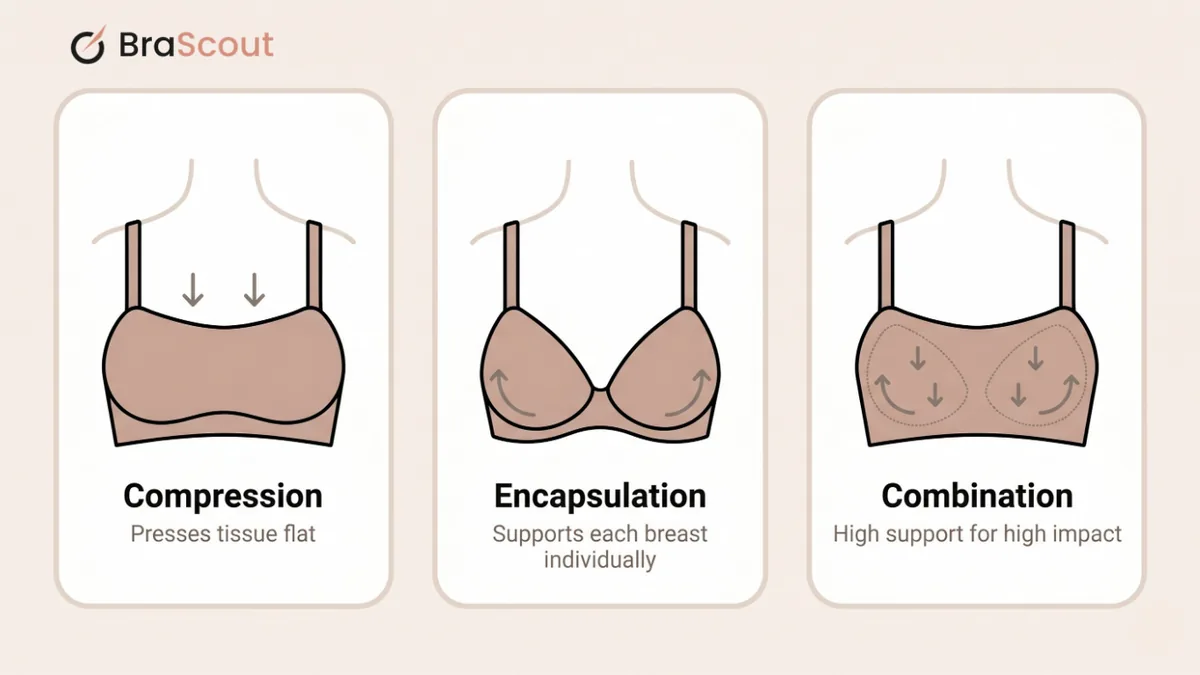
There are two ways a sports bra fights movement, and the difference is the whole game:
- Compression presses everything flat against your chest wall, so there's nothing loose to bounce. Simple, and what most cheap "sports bras" do.
- Encapsulation wraps and supports each breast separately in its own shaped cup — like a regular bra, but built to lock tissue down rather than just hold it.
Low-impact movement (yoga, walking) is fine on compression alone. But high-impact — running, HIIT, jump rope, anything where both feet leave the ground — needs the heavy artillery: a combination bra that compresses and encapsulates, usually with a wide band, a tall centre panel between the cups, and firm, barely-stretchy fabric. If your "high-impact" bra is really just a stretchy crop top, it's a compression bra in a costume, and it will lose.
The band does the work — yes, even here
Same rule as every other bra: the band carries roughly 80% of the support, not the straps. In a sports bra, a wide, firm underband is what actually anchors everything and absorbs the impact. Which is exactly why sizing up the band for "comfort" backfires — a loose band rides up mid-burpee and dumps the whole load onto your shoulders. You want it snug enough that it doesn't budge when you jump. Straps matter too (wide, cushioned, ideally adjustable or racerback so they don't slip), but they're the supporting cast, not the star.
How to tell if it's actually high-impact (the 30-second test)
Before you trust it on a run, test it standing in the fitting room:
- Jump. Genuinely jump up and down for ten seconds. Minimal movement = pass. Visible bounce = it isn't high-impact, whatever the tag claims.
- Band check. Two fingers under the band — snug, doesn't pull far away. Raise your arms overhead; the band should stay put, not ride up.
- No spillage. Tissue fully contained, top and sides. Overflow at a standstill becomes chafing at a sprint.
- Breathe. Firm is the point; can't-take-a-full-breath is too tight. There's a line, and you'll feel it.
If you're not sure what "a band that fits" even feels like, our 60-second fit test walks through every check.
Match the bra to the movement
Impact isn't all-or-nothing. A rough guide:
- Low (yoga, pilates, walking, light weights): a compression bralette is plenty.
- Medium (cycling, hiking, elliptical): compression, or a light combination bra.
- High (running, HIIT, dance, jump rope, team sport): combination, wide band, encapsulated cups — non-negotiable. And more so the larger you are: bigger busts feel high-impact forces harder and get the most out of true encapsulation.
When to retire it
Sports bras die faster than everyday ones — sweat, heat and constant stretching chew through the elastane. The tell is the same as any bra: when the band no longer grips firmly on the tightest hook, or has stretched out entirely, the support is gone even if it still looks fine. A washed-out, slack sports bra is just a crop top with ambitions. Rotate a few so each one rests, air-dry them rather than tumble-drying (the dryer's heat is what kills the stretch), and replace once the grip goes.
Buying for the gym? Start with your actual size.
Sports-bra fit falls apart fast if your band size is off — and your everyday bras have probably been lying to you about it. Find the size your body is actually asking for, free, in about two minutes.
Find my sizeEncapsulation sports bras built for full-bust movement, not just compression crop tops:
BraScout may earn a commission if you buy through these links, at no extra cost to you. See our Affiliate Disclosure.
Keep reading:
- Your band creeping up mid-run is the support quitting on you → Why Your Bra Band Rides Up
- Not sure what a band that actually fits feels like? → How to Tell If Your Bra Fits
- Sports bras die fastest of all — here's when yours is done → When to Replace Your Bra
Frequently asked questions
What makes a sports bra high-impact?
A combination of compression and encapsulation, a wide firm band, a tall centre panel between the cups, and low-stretch fabric — engineered to control breast movement in every direction, not just press it flat. A stretchy crop top does none of that, whatever the label says.
Is compression or encapsulation better for running?
For running you want both. Compression alone lets larger tissue keep shifting; encapsulation alone can lack overall lockdown. High-impact combination bras do both at once, which is why they outperform a basic compression crop for running and other high-impact activity.
Should a high-impact sports bra feel tight?
Snug and firm, yes — that firmness is the support working. But you should still be able to take a full, deep breath. If it restricts your breathing or digs in painfully, the band is too small. Fix the band size rather than just enduring it.
How often should I replace a sports bra?
When the band stops gripping firmly — usually sooner than everyday bras, because sweat and heat break the elastic down faster. If it has gone slack or rides up when you move, the support is finished no matter how it looks. Air-drying instead of tumble-drying makes it last longer.