
When to Replace Your Bra: The Signs It's Actually Done
We need to talk about The Bra. You know the one. It's technically beige now but it started life white, it lives on the very last hook, and you defend it like a member of the family — "no, but it's so comfortable." Okay. Deep breath. Someone has to be the friend who says it in the changing room, so it's going to be me: it's comfortable because it gave up. That bra stopped actually holding you up months ago, and you've quietly been carrying the difference on your own two shoulders the whole time. Nobody teaches us this, so it's not your fault you've been wearing a ghost — but let's fix it. Here's how to tell when a bra is genuinely done (past the denial), and how to keep the good ones alive about twice as long.
A worn-out bra stops supporting you — and you pay for it
The band is the engine. It carries roughly 80% of a bra's support, gripping firmly around your ribcage — not hanging off your shoulders. It does that one job with elastane, and elastane is a consumable: it stretches, holds, and eventually fatigues and stops snapping back. Once the band can't grip, it creeps up your back, and all the support it used to give gets dumped onto your straps. That's when the shoulder grooves, the aches, and the "why does this bra hurt now when it used to be fine?" start. Same bra, same size — but the structure underneath has expired. Nothing on the outside has to look wrong for the support to be completely gone.
A bra can look brand new and be totally finished. The elastane that does the supporting dies long before the fabric ever frays or fades — so "but it still looks fine" tells you nothing about whether it still works.
How long a bra actually lasts
Brace yourself, because this number stings: a bra in regular rotation has a working life of around 6 to 12 months of real support. Yes — months. (The bra you're thinking of right now is doing the math too.) And it's not because the fabric falls apart; it's because the elastic does. Body heat, sweat, friction and washing all break elastane down, and once it's gone the band simply can't anchor anymore. Sports bras die fastest of all, since they cop the most sweat and the most stretching. The exact number matters less than the principle: a bra is a wear item, like running shoes, not a forever object. If you've had the same daily bra for two years and never retired it, it gave up on you a long time ago — you just slowly got used to the decline.
The tells: how to know yours is done
The denial is strong with this one — we've all clung to a bra well past its expiry because binning underwear that "still works" feels wasteful. So don't trust your feelings here, and don't go by the calendar either. Go by the band. Quick checks:
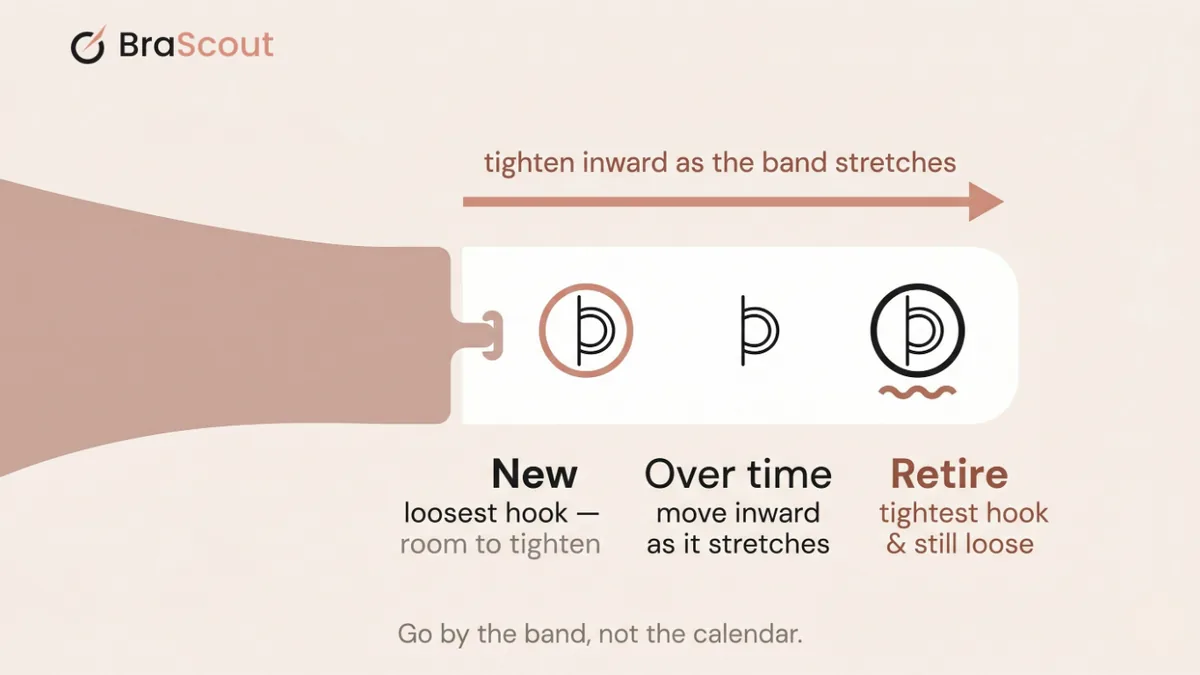
- The tightest-hook test. A new bra should fit on the loosest hook, so you can tighten inward as it stretches over its life. If you're already on the tightest hook and the band still feels loose or pulls away from your back, you've run out of room to tighten — it's done.
- It rides up. A band that creeps up your back during the day has lost its grip. That's the elastic giving up, not your imagination.
- You're constantly adjusting it. Yanking the band down, re-tightening straps, repositioning all day — that's a bra you're holding up, not one that's holding you up.
- The cups gape or the shape's gone. Stretched-out cups that wrinkle, bag, or no longer fill the way they used to.
- It aches now and didn't before. Same size, new shoulder or back ache usually means the band has quit and your straps are taking the whole load.
Rule of thumb: if two or more of these are true, replace it — even if it looks fine. Especially if it looks fine.
How to make the good ones last
You can't stop elastane from dying, but you can slow it down a lot:
- Rotate several — ideally around five. Wearing a different bra each day gives the elastic 24–48 hours to recover its stretch between wears. Wearing the same one two days running ages it fastest.
- Never tumble-dry. The dryer's heat is the single worst thing for elastane — it cooks the stretch right out. Air-dry flat, every time.
- Wash gently, not constantly. Hand-wash, or machine-wash inside a mesh laundry bag on cold/delicate — hooks done up so they don't snag — every couple of wears rather than every single one.
- Don't wring or twist them. Press the water out; twisting wrecks the shape and the fibres.
None of this makes a bra immortal. It just gets you toward the top of that 6–12 month range instead of the bottom.
The exception: don't bin a good bra over a tight band
Sometimes the band gets snug after a bit of weight change, but the cups still fit your volume perfectly. Don't throw it out — a cheap bra extender adds a row of hooks and a couple of inches of band, and you keep a bra that's otherwise completely fine. (The opposite case — band's loose but the cups are right — is a sister-size question, not a bin-it question.) The whole point: replace a bra when the support is gone, not every time something feels slightly off. Sometimes it's a five-euro fix, not a new bra.
Replacing a few bras? Re-measure first.
Replacement time is the perfect moment to stop re-buying the same wrong size you've worn for years. Find the size your body is actually asking for — free, in about two minutes — before you spend a cent.
Find my sizeSolid, long-wearing everyday brands worth restocking when your old bands give out:
BraScout may earn a commission if you buy through these links, at no extra cost to you. See our Affiliate Disclosure.
Keep reading:
- A band that rides up is usually a band that's worn out → Why Your Bra Band Rides Up
- Band loose but the cups still right? That's a sister-size move, not a bin-it → Sister Sizes Explained
- The bras that wear out first — and what a real one looks like → High-Impact Sports Bras
Frequently asked questions
How often should you replace a bra?
Roughly every 6 to 12 months of regular wear — but go by the band, not the calendar. The elastic that does the supporting wears out before the fabric ever looks worn, so once the band no longer grips on the tightest hook, the bra is finished regardless of its age.
How do I know when my bra is worn out?
The band rides up your back or feels loose even on the tightest hook, you find yourself constantly adjusting it, the cups gape or have lost their shape, or it suddenly aches when it never used to. If two or more of those are true, replace it — even if it still looks fine.
Does the way I wash my bra affect how long it lasts?
A lot. The heat of a tumble dryer destroys the elastane that does the supporting, so always air-dry. Hand-wash or use a mesh laundry bag on a cold, gentle cycle, and rotate several bras so the elastic in each one has a day or two to recover between wears.
My band feels tight but the cups still fit — do I need a new bra?
Probably not. If the cups still fit your volume well and only the band has become tight, a cheap bra extender adds a couple of inches of band and saves a bra that is otherwise perfectly good. Replace a bra when the support itself is gone, not every time something feels slightly off.