
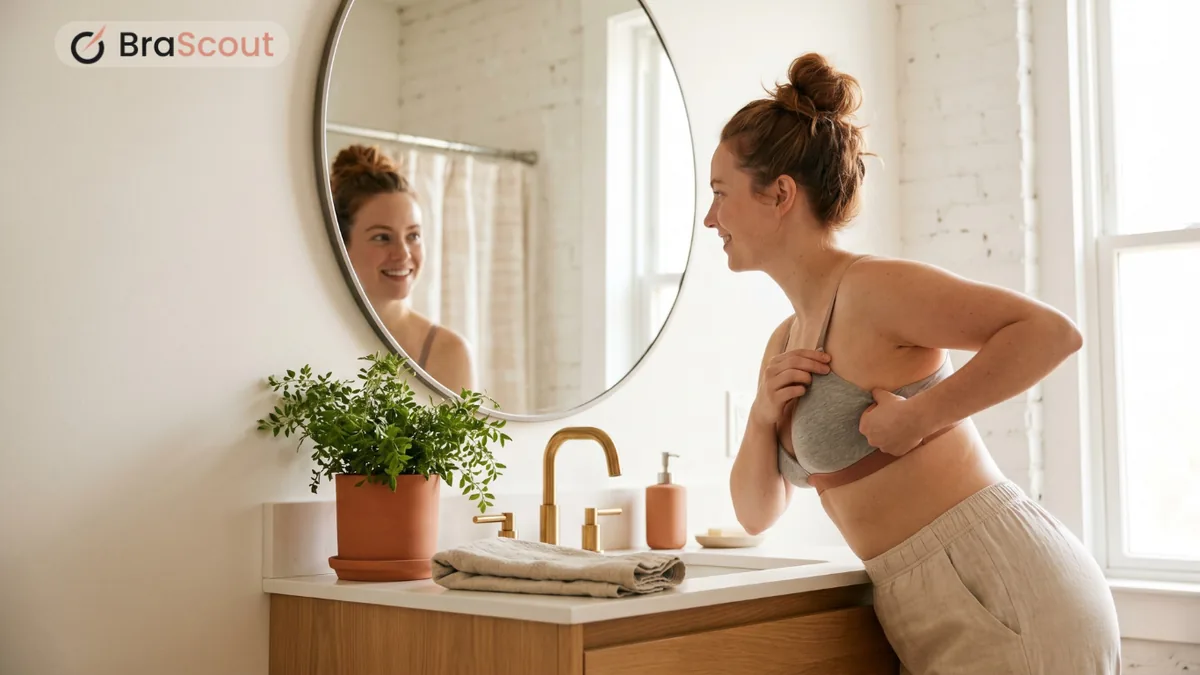
How to Tell If Your Bra Fits: The 60-Second Mirror Test
You don't need a fitting room to know whether a bra fits — you need a mirror and about a minute. These are the same checks a professional fitter runs, just without the awkward small talk. Run through them and you'll know exactly where a bra is failing you, and what to do about it.
First, the one rule that explains most of it
Your band does roughly 80% of the support work — not your straps. So when you're checking fit, the band is where you start, and most failures trace back to it being too loose. Keep that in mind and the rest of the test makes sense.
The checks
Stand in front of a mirror and run these in order. Any two fails means the bra is the wrong size or the wrong shape for you.
- Band tension. Slide two fingers under the back band. They should fit snugly and you shouldn't be able to pull the band more than an inch off your back. Fail: it stretches away like a slingshot.
- The arm raise. Lift both arms straight overhead for a few seconds. Pass: the band stays level. Fail: it shimmies up toward your shoulder blades.
- Scoop and swoop. Lean forward and sweep all your tissue into the cups (more on this below). Pass: everything sits inside the wire. Fail: it spills over the top or the side.
- The gore. The little bridge between the cups should lie flat against your breastbone. Fail: it floats off your chest.
- Strap release. Slip both straps off your shoulders. Pass: the bra stays up on the band alone. Fail: the front sags or collapses.
- Cup surface. Cups should be smooth. Fail: wrinkling and empty pockets (too big), or a ridge cutting in (too small).
- Bend forward. Tip forward to 90°. Pass: tissue stays put. Fail: it falls out the top or under the wire.
- Side view. Turn sideways, arms out. Pass: a smooth line from chest to armpit. Fail: a pucker of tissue over the band wing.
- Breathing. Take a deep breath. Pass: the band flexes, no pain. Fail: it compresses your ribs or you're breathing shallow.
- Profile. From the side, your bust should sit lifted, roughly midway between shoulder and elbow. Fail: flattened, sagging, or splayed outward.
The one move that fixes half of these
Most people put a bra on and leave half their tissue behind at the sides. The scoop and swoop fixes that: once the bra's on, lean forward, reach into each cup, and sweep all the tissue from your side and underarm forward into the cup. Stand up and adjust. It's step three of the test and a daily habit — it gives instant lift, a smoother line, and stops tissue drifting to your armpits through the day. If a bra borderline-fails the scoop-and-swoop check, do the swoop properly before you blame the bra.
What a good fit feels like: the band is snug and level and you forget it's there; the cups are smooth with nothing spilling or gaping; the straps could slip off and nothing would move. If you're constantly adjusting, hiking, or tugging — that's a fit talking, not you being fussy.
Failing a few of these? It's usually size. Find your size and sister sizes in 2 minutes — free, no signup.
Find my size →Keep reading:
- Not sure of your number yet? Start here → How to Measure Your Bra Size at Home
- Pinpoint a specific failure and its fix → Bra Fitting Problems: 9 Common Issues and How to Fix Them
- The most common fail of all → Why Your Bra Band Rides Up
How do I know if my bra fits?
Check four things in a mirror: the band should sit snug and level across your back (not riding up), the cups should be smooth with no spillage or gaping, the center gore should lie flat against your breastbone, and the straps should only be stabilizing — not holding the whole bra up. If the band is doing its job, most of the rest falls into place.
What's the most common sign of a bad bra fit?
A band that rides up your back, and straps that dig into your shoulders. They're usually the same problem: a band that's too loose can't support you, so the weight dumps onto your straps. It's the single most common fit failure, and the fix is almost always a snugger band.
Can I check my bra fit without a professional fitter?
Yes. A mirror and about 60 seconds covers the same checks a fitter uses — band tension, the arm-raise, the scoop-and-swoop, the gore, the strap-release, and the cup surface. A fitter is helpful for hard cases and large cups, but most people can diagnose their own fit at home.