
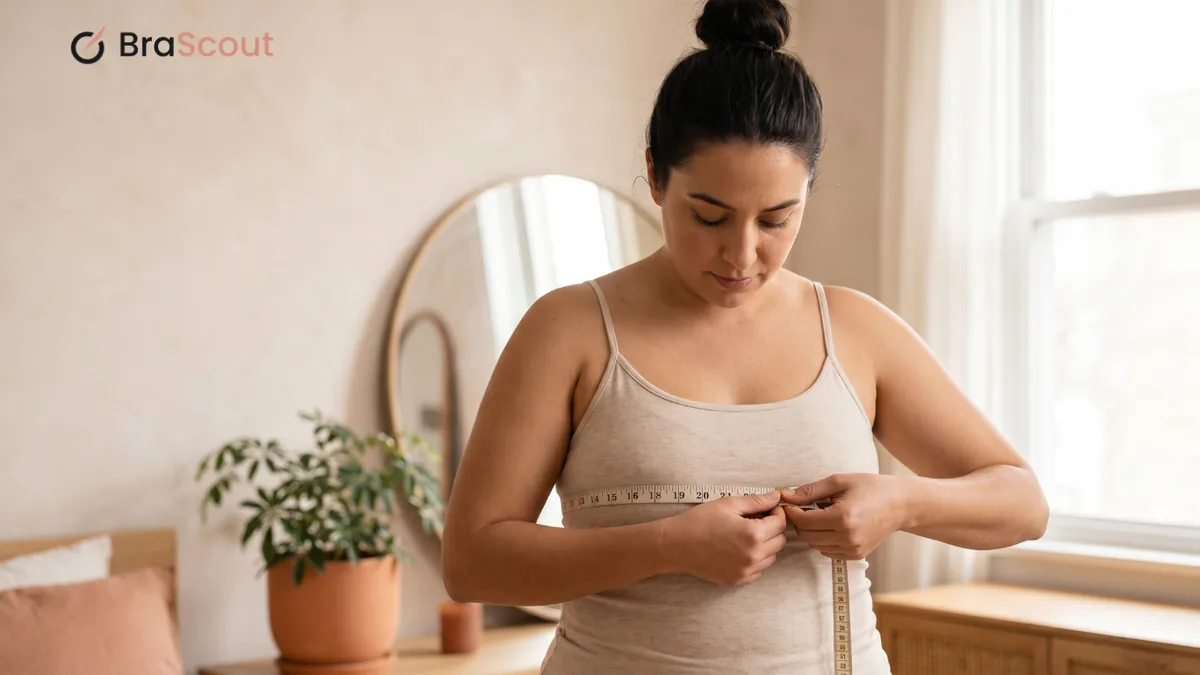
How to Measure Your Bra Size at Home (And Actually Get It Right)
You don't need a fitting room or an app to measure your bra size — a soft tape measure, a mirror, and two minutes will do it. The catch is measuring right. Almost every "I wear the wrong size" story starts with one bad measurement, usually a band pulled too loose or a bust pulled too tight. Get those two right and the rest is arithmetic.
What you need
- A soft fabric tape measure (the kind for sewing, not a metal builder's tape).
- A mirror, and ideally a thin, non-padded bra or no bra at all.
- Good timing: measure mid-cycle, not in the days right before your period — fluid retention can temporarily inflate breast volume by up to about 25% and throw your cup size off.
Step 1 — Your band
Wrap the tape around your ribcage directly under your bust, where the band of a bra sits. Keep it level with the floor all the way around, and pull it snug — firm, like a band is supposed to feel, not loose. Breathe all the way out and read the number on the exhale (that's your true ribcage minimum). Round to the nearest even number: 33.5" becomes a 34 band.
Step 2 — Your bust
Now measure across the fullest part of your bust, usually at nipple level. This time the tape rests light — no pulling, no compression, no flattening. Pulling tight here is the classic mistake: it shrinks the difference and hands you a cup that's too small. (If your tissue is soft or full, lean forward 45–90° so it falls forward and you capture its real volume.)
Step 3 — The math
Your cup size is simply the difference between your bust and band measurements. Each inch of difference is one cup size:
| Bust − band | US | UK | EU |
|---|---|---|---|
| 0" | AA | AA | AA |
| 1" | A | A | A |
| 2" | B | B | B |
| 3" | C | C | C |
| 4" | D | D | D |
| 5" | DD / E | DD | E |
| 6" | DDD / F | E | F |
| 7" | G | F | G |
| 8" | H | FF | H |
| 9" | I | G | I |
| 10" | J | GG | J |
So a 34 band with a 38" bust is a 4" difference — a 34D (US/UK) or 34E (EU). Notice the columns drift apart above a D: that's exactly why "your size" behaves differently depending on where a brand is from.
Start on the loosest hook
When you put a new bra on, it should fit on the loosest hook — the outermost set. Bands stretch as they age, so starting loose gives you somewhere to go: you tighten to the inner hooks over the months as the elastic relaxes. If a brand-new bra only feels supportive on the tightest hook, the band is already too big and it'll be useless in a few weeks. Loosest hook on day one is the rule.
How often to remeasure
Your size is not a fixed number. It shifts with weight changes, hormones, pregnancy and nursing, and age as tissue elasticity changes. Remeasure every 6–12 months, and any time your body has obviously changed. Most people are long overdue — if you can't remember the last time you measured, that's your sign.
One honest limit: tape gives you band and volume only. It can't read your breast shape — projection, root width, where your fullness sits — and shape decides which styles actually suit you. And no two brands cut identically, so your measured size is a strong starting point, not a guarantee in every label.
Skip the arithmetic — get your size, every regional conversion, and your sister sizes in 2 minutes. Free, no signup.
Find my size →Keep reading:
- Got your number? Now check it actually fits → How to Tell If Your Bra Fits
- Why your measured size still behaves differently brand to brand → Why Your Bra Size Is Different in Every Brand
How do I measure my bra size at home?
You need two measurements with a soft tape. First, the band: wrap the tape snugly around your ribcage directly under your bust, level with the floor, and read it on a full exhale — round to the nearest even number. Second, the bust: measure loosely across the fullest part, with no compression. Your cup size is the difference between the two — each inch of difference is one cup size.
Should I measure my band snug or loose?
Snug. The band does about 80% of a bra's support work, so it needs to be firm. Pull the tape snug around your ribcage and read it as you breathe out fully. The bust measurement is the opposite — that one should be light, with the tape resting on the tissue without squashing it.
Why is my measured size different from what I usually wear?
Very common. A lot of people wear a band that's too big and a cup that's too small, and brand vanity sizing muddies it further — the same label is cut differently from brand to brand. Treat your measured size as a reliable starting point, then check the fit and try sister sizes from there.