

Bras for Sensitive Skin: It's Usually the Bra, Not You
You peel your bra off at the end of the day and there it is: the angry red line carved under your band, maybe an itch you've been absent-mindedly scratching through your shirt since two o'clock. And somewhere along the way, you quietly decided this was just your lot — that you have "sensitive skin," that you and bras are simply at war and always will be. Can I gently push back on that? Most of the time, it isn't your skin being dramatic. It's the bra. Irritation under a bra is almost always a signal — friction, trapped sweat, a wire in the wrong place — and signals can be fixed. Here's what's actually going on under there, and how to sort it without resigning yourself to a lifetime of red marks.
Redness and chafing aren't something to just put up with
First, a mindset shift, because it changes everything that follows. A rash, persistent redness, or chafing under your bra is not a personal failing and not something you're meant to grit your teeth through. It's your skin reporting a mechanical problem — usually friction, or a wire pressing where it shouldn't. Once you stop treating it as "my difficult skin" and start treating it as "my bra is doing something wrong," it becomes a fixable list instead of a life sentence.
What's actually irritating you
There are really only a handful of usual suspects, and you can often spot yours by where and when it shows up:
- Friction. A band that's too loose slides around as you move and rubs the same strip of skin all day. A wrong-sized band does the same. Movement plus repetition equals chafing.
- Trapped sweat. Synthetic, non-breathable fabric holds moisture against your skin for hours. Warm, damp, enclosed — that's the exact recipe for irritation, especially under the band and in the crease beneath the breast.
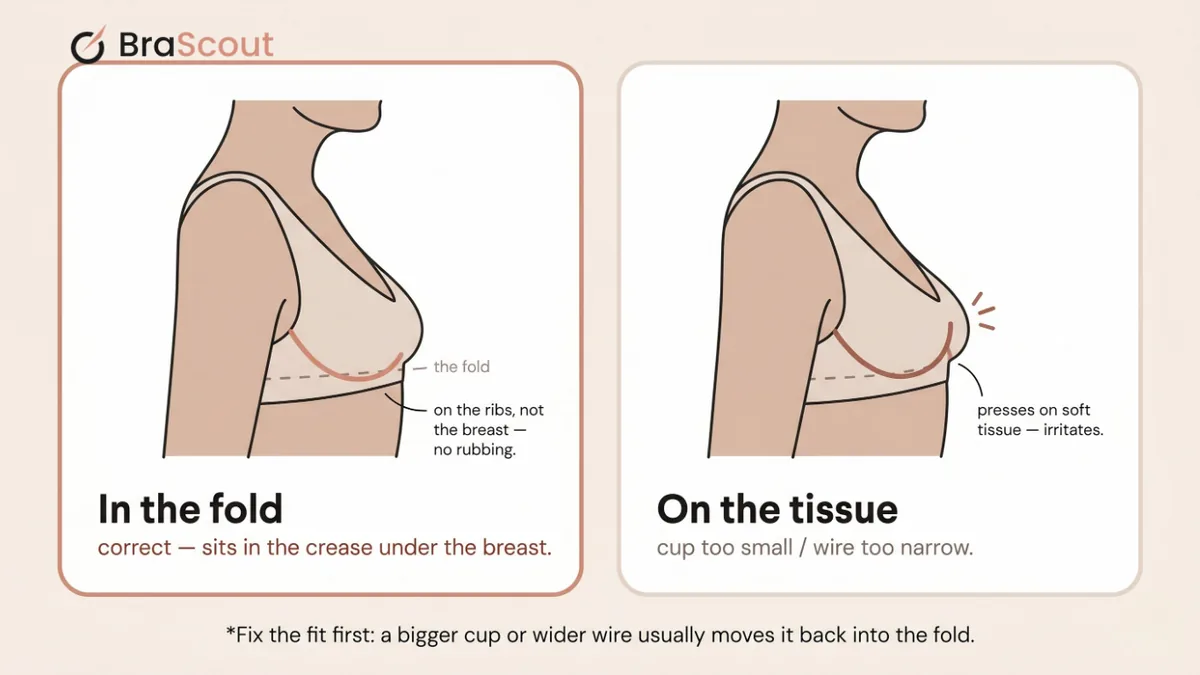
- A wire on your tissue. An underwire is supposed to sit in the inframammary fold — the crease under the breast — not on the breast itself. If the cup's too small or the wire's too narrow, it rides up onto soft tissue and presses there all day. That's not "sensitive skin," that's a wire in the wrong place.
- The metal hooks. If cheap earrings make your earlobes react, the hooks and adjusters on your bra might be doing the same thing to your back. That's a nickel allergy, and it's more common than people realise.
The quick tell: irritation in a line under the band usually means friction or a too-tight band; irritation on the breast itself often means the wire is sitting where it shouldn't; a reaction right where the hooks sit points at the metal.
How to fix it, cheapest and highest-impact first
Work this roughly in order — the first fix solves the most cases:
- Get the size right first. A band that fits grips firmly without sliding, so it stops rubbing; the right cup puts the wire down in the fold instead of on your tissue. Most under-band irritation quietly disappears the moment the fit is correct. This is the root fix, not a nice-to-have.
- Switch to a breathable, natural fabric. Cotton or bamboo lets your skin breathe and wicks moisture instead of trapping it. For day-long wear against reactive skin, this is the single best fabric move.
- Don't ditch the underwire — relocate it. If the wire's the problem, try a bigger cup or a wider wire so it sits in the fold, before you give up on underwire entirely. If it still bothers you after that, a wire-free bra is a completely valid choice — just fix the fit first so you're not solving the wrong problem.
- Go nickel-free if metal's the trigger. Bras with coated or nickel-free hardware exist specifically for this.
- Keep it clean and dry. Wash gently and rinse the detergent out fully — residue is its own irritant — and don't re-wear a sweaty bra two days running. Rotate a few, and give your skin some bare time when you can.
- Choose soft, wide, seamless bands. A wider band spreads pressure over more skin instead of cutting a single hard line, and seamless edges have less to chafe against.
When it isn't the bra
One careful note to close on. Almost all bra-related skin irritation clears up once you fix the fit and the fabric — that's the happy ending here. But if you've genuinely sorted both and a rash, redness or scaly patch still won't settle, or the skin on your breast looks dimpled or puckered like the surface of an orange, stop treating it as a laundry problem and have a doctor take a look. To be clear, your bra didn't cause that — a band or a wire doesn't cause anything sinister — but a skin change that persists after the obvious fixes deserves a professional eye rather than another new bralette. Putting your bra on each day is a perfectly good moment to stay familiar with what's normal for your skin.
Most irritation starts with the wrong band
Before you buy a single "gentle" bra, find out what size your body's actually asking for — a band that fits is the fix for most under-band rubbing. Free, about two minutes.
Find my sizeBreathable natural fibers, flat seams, and wire-free builds that cut friction and trapped moisture:
BraScout may earn a commission if you buy through these links, at no extra cost to you. See our Affiliate Disclosure.
Keep reading:
- If the wire's the culprit, here's exactly why it digs → Underwire Poking or Digging?
- Most irritation is a fit problem in disguise → How to Tell If Your Bra Fits
- An old, sweat-saturated bra is its own irritant → When to Replace Your Bra
Frequently asked questions
Why does my bra irritate my skin?
Usually it's friction or trapped sweat rather than skin that's simply sensitive. A loose or wrong-sized band slides and rubs, synthetic fabric traps moisture against your skin all day, or the underwire sits on tissue instead of in the crease beneath the breast. Sometimes it's a nickel allergy reacting to the metal hooks and adjusters.
What kind of bra is best for sensitive skin?
A well-fitting one in a breathable natural fabric such as cotton or bamboo, with a soft, wide band that grips without sliding, and nickel-free hardware if metal is your trigger. Getting the size right matters more than any single feature, because most irritation starts as friction from a bad fit.
Should I stop wearing underwire if it irritates my skin?
Not necessarily. Underwire usually irritates because it's the wrong width or the cup is too small, so the wire rests on breast tissue instead of in the fold beneath it. Try a bigger cup or a wider wire first. If irritation continues after the fit is corrected, a wire-free bra is a perfectly good option.
When should I see a doctor about skin irritation under my bra?
If you've corrected the fit and switched to a breathable fabric and a rash, redness or scaly patch still won't clear up — or the skin looks dimpled or puckered like orange peel — have it checked by a doctor rather than continuing to treat it as a bra problem.